

Thoroughbreds: a review and analysis
an unsettling watch

My best friend asked me to review a movie. The only challenge was that it shouldn’t be a horror movie. And, well, technically Thoroughbreds is not a horror movie. But it is deeply unsettling. It is a suspense thriller that uses both psychological tension and the bizarreness of teenage feelings to build tension. Deranged, as a descriptor, would be an understatement.
In the start, there’s a horse, there’s a knife, and there’s a show of wealth. The perfect ingredients to start a tale of restless succumbing to maladies.
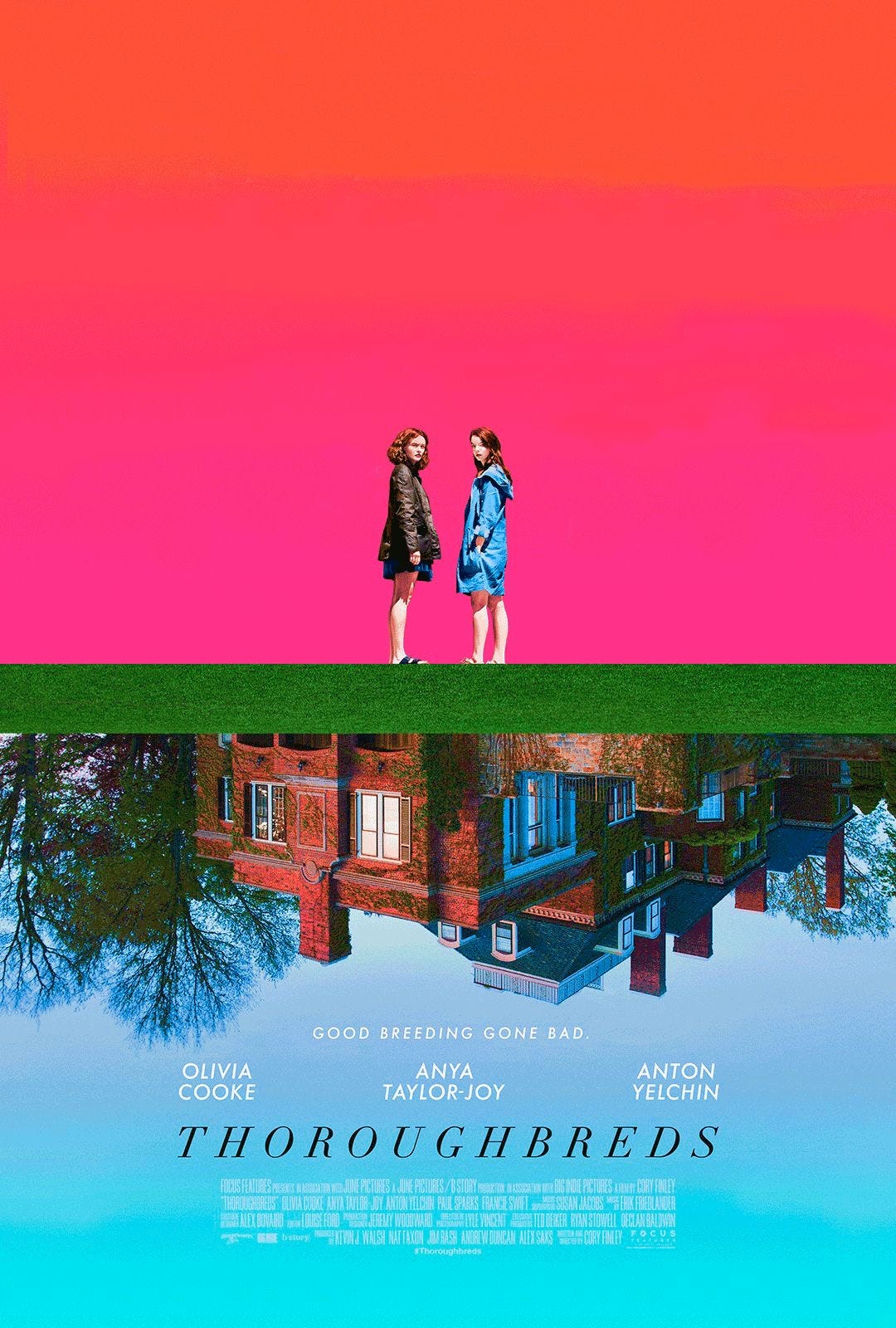
First, a little description of the movie:
The movie follows two friends, Lily (Anya Taylor-Joy) and Amanda (Olivia Cooke), who have known each other since childhood. Lily is offering to tutor Amanda, and seemingly, Lily has already finished her boarding school, and Amanda is in need of company – to the point that her mother is ready to offer compensation for it. Lily is unsettling in rather inexplicit ways in the beginning, whereas Amanda’s character starts with a highlighted statement about how she doesn’t feel any emotions, ever. As we see their ‘friendship’ unfold, we’re also introduced to Lily’s parents – the insufferable stepdad, Mark, who Lily is dead set on murdering, and the mother, who can’t seem to think of anything else apart from what Mark wants her and Lily to be. And the tale begins.
Chapter I
I was unnerved by Lily’s character from the beginning. She was first introduced as her wealth – which is already enough to be scared of someone, but it only got better. There’s Amanda, on the other hand, whose derangedness was no secret from the beginning. She was introduced as a “creepy friend”, who has violent tendencies and is emotionless. When Amanda notices Lily hates her stepdad, it is a very quick interpretation that we don’t get to see the background workings of. It could be that she knows because of their history together, or something about that particular interaction. But, at the moment, I felt like it might have been better to show us a little bit of the why as well. However, more on this later.
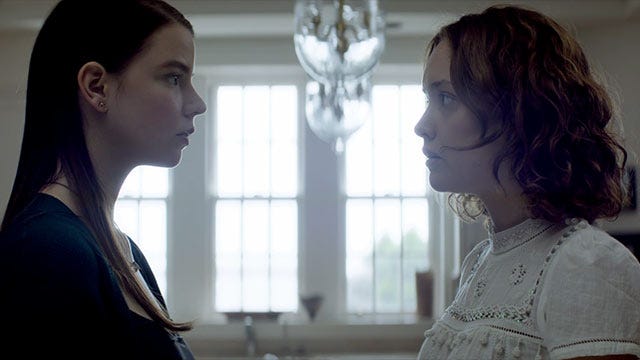
Lily is terrifying for underlying reasons. Her wealthy smile, her way of saying the perfect things in the beginning, and her hatred of her stepdad, makes her, overall, jolting. Amanda’s character, I took an instant liking to. About her lack of emotional responses, she said “And that doesn’t make me a bad person. Just means I’ve to work a little harder than everyone else to be good.” At some point in Chapter 1, Amanda plants the idea in Lily’s head: “Do you ever think about just killing him?”
I, personally, wasn’t aware of Amanda’s name till Chapter 2 of the movie. She was mostly referred to as the ‘freak friend’ or the ‘creepy friend’. It could totally have been a miss on my part, however, it was also not highlighted or used in the movie for me to be aware of it. And because of this reason, I think, in the first half of the movie, Amanda was supposed to be present more as an emotion than as a character. Naming of something gives its presence substance. And lack of a name means that we fill that void of substance with something else to give it meaning. The movie’s extreme focus on her lack of emotions makes her lack an ever-present thing on the watcher’s mind. Her lack transforms into a presence of a sort. The movie, therefore, plays on knowledge. Because, as Adam Phillips reminds us, the idea of truth lets us know whose side to be on. And Thoroughbreds, from the start, made it extremely apparent that Amanda was terrifying, for reasons we might not be able to decipher.
This, the director (Cory Finley), did wonderfully. It was important to what a core part of the movie is: the slow translation of Amanda to Lily in derangeness. Because at the end of Chapter 1, we find out not everything about Lily might be true.
Chapter II
We do not see Lily’s mom till Chapter 2 – she would do anything to make Mark, the stepdad, happy. And we find out Lily’s rich friends are freaked out by Amanda. It is important to note that while Lily is extremely rich, Amanda is from the same suburb – so it is not a story where one friend has very little means and then there’s the wealthy friend.
Here starts the slow opening up of Lily’s character. By ‘opening up’, I mean, we see the potential of her dementedness. After Amanda saves Lily from drowning, Lily slowly asks Amanda about when she’d mentioned killing Mark and not getting caught. Lily only needed to know that she has support and someone to turn to when there’s a murder – and it unfurls something deep inside her. The reasons for her dislike towards Mark increase when she finds out that he’s trying to send her away to a school for students with behavioral issues, which is quite far from home.
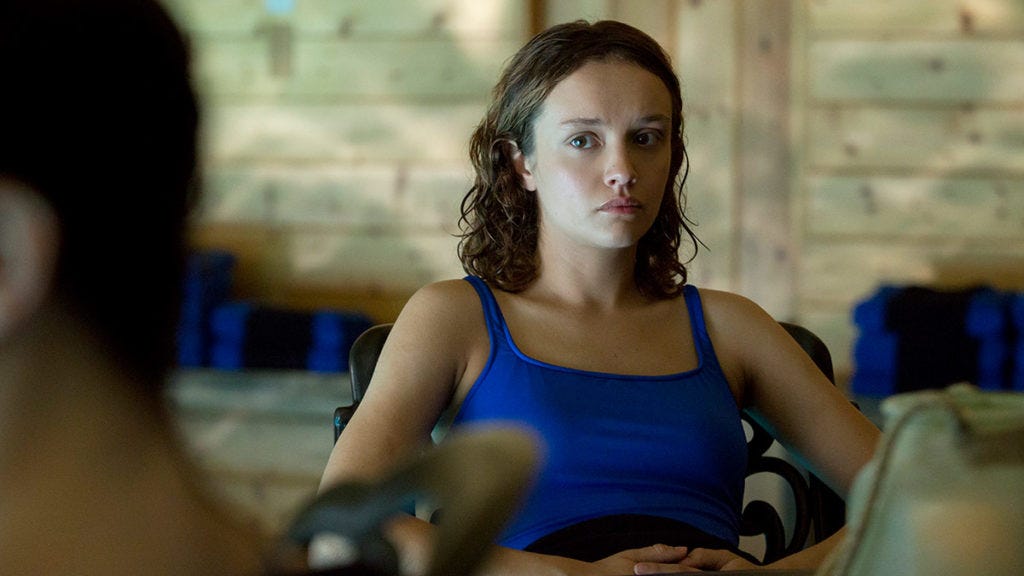
Then there’s the part about Amanda’s horse, Honeymooner. Lily asks one of her friends for the photos of the murdered horse and then starts a conversation with Amanda about it. Here, we find out why she executed it: it couldn’t walk and was in pain, and her mom wouldn’t go to a vet to put it down. She tried to find the most humane way to do it but then had to cut through its neck to reach its spine to finally put it out of its misery. And thus, we learn that it’s not that Amanda can’t feel what the right thing to do would be, but she also felt nothing about cutting through the neck.
This marks an important shift from Amanda to Lily. We start seeing reasons and understanding more about Amanda’s behavior. Plus, is empathy really all that common? The movie does an incredible job in showing that Lily isn’t really being affected or inspired by Amanda. It is entirely her who is capable of thinking of killing Mark. Thoroughbreds also isn’t a gory film – even with multiple potential ways it could have shown even a little bit of gore, it doesn’t do it. Instead, it uses Erik Friedlander’s incredible score to build what it could have with visual imagery. Because the audience will find themselves already excessively preoccupied with the potential of something like gore, and the movie finds the outlet for pleasure of excessive displeasure through music.
Chapter III
This chapter is all about putting their plan to action. They’re decided on killing Mark. And they find this local creep (played by late Anton Yelchin) who dreams of becoming someone big in ten years, who, ultimately, bails on them and never shows up to do the actual killing. And finally, after 1 hour 7 minutes of the movie, Amanda tells Lily that she knows that Lily was expelled from her school, and that the internship is fake.

Lily scares me more than Amanda. And this is a good point to mention this because although Amanda never really scared me, her ways of being very unsettling are highlighted by the movie, especially in the beginning. And this is the point when the displacement of Lily to Amanda’s place is almost complete. Thoroughbreds always made it clear what exactly it is that makes Amanda’s character a little off putting, however it is only slowly that we realize Lily’s frenzy – without much reason for it.
This is also a good point to bring back what I’d mentioned about the movie not showing why Amanda thought Lily hated Mark the stepdad. Borrowing from Mark Fisher, the suspension of the categories that we’ve used to make sense of the world till now involves a “sensation of wrongness” (15), and Thoroughbreds goes to a wonderfully perfect length to not tell us what it is about Mark that makes Lily loathe him so much. Sure, he’s an asshole like most filthy rich stepdads, yells at her mother, and uses this ‘ergometer’ technology whose slow thumping sound makes Lily go insane. But, at the same time, the movie goes out of its way to also show us that, perhaps, he is just a normally insensitive, unlikeable person. We do not see any history or specific moments that really make a case for Mark being murdered. And to me, at least, it did not make sense.
Chapter IV
Perhaps, Thoroughbreds did not want to make sense out of it. “The unacceptable, to some extent, can be known; the unintelligible can only be acknowledged” (17, Phillips). The movie first familiarizes us with Lily but then goes through a deep process of defamiliarization – and playing with knowing and knowledge is one of the best ways to unsettle. And what’s better than playing with knowledge? Playing with something that “cannot be solved by knowledge” (7, Phillips).
Amanda and Lily’s relationship is not one of friendship. They’re people who know each other, they can help and love each other, they seek comfort in each other. But it’s one of deep apathy. Humans are slaves to familiarity, and familiarity breeds dependence on itself. Adam Phillips writes “Once there is dependence – once there is acknowledgement of another person as a source of satisfaction – demands are always questions: ‘I want’ becomes ‘Can I have?’” (3, Phillips). But it is kind of reversed here: Lily takes what she thinks is reserved for her.
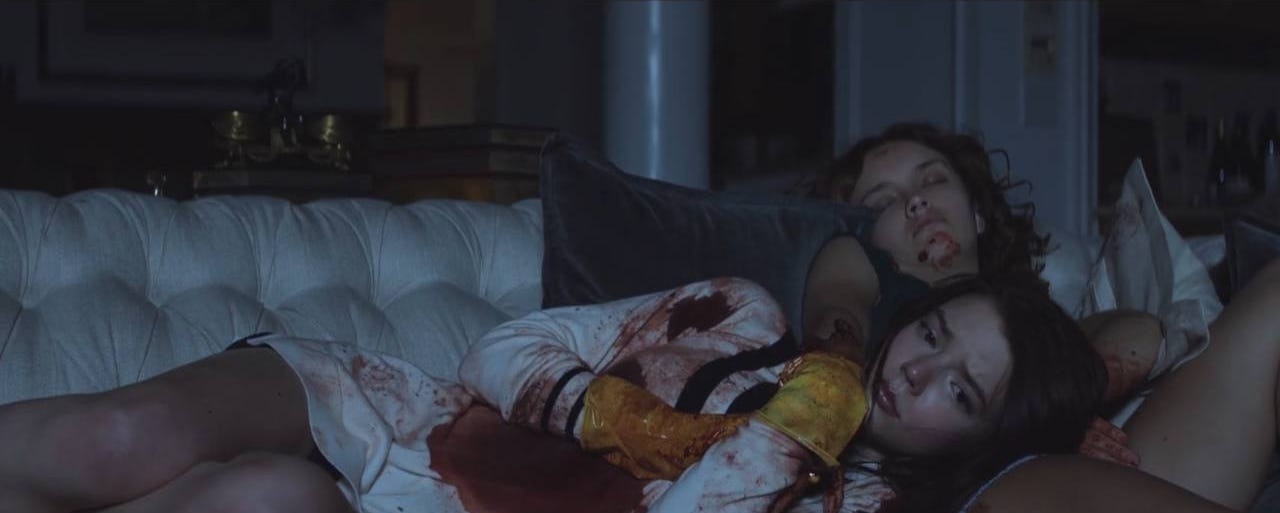
Lily first asks Amanda if she thinks her life is worth living, because of her lack of emotional responses, and then drugs her drink so that she can frame Amanda for her father’s death. She tries to stop Amanda from drinking it, but Amanda gulps it down and loses consciousness. Lily follows through with her plan. Here, too, there’s no gore. Instead, the camera stays on Amanda’s unconscious body, as, in the background, the ergometer stops, there are thuds, and Lily comes back with a knife, and bloody dress and gloves. She smears the blood on Amanda’s arms, then although she is moving away, she comes back, puts Amanda’s unconscious arms around herself, and lays down in her lap. It’s the only point in the movie when I paused to take a screenshot.
Amanda ends up in a psych ward, where she seems to be doing better than everyone else there in activities, but has nightmares about Lily and her horse. And Lily continues with her life.

There are many ways to watch and analyze this movie: their friendship, the role of capitalism, the significance of the horse, and teenage angst. Among many others. I’ve mostly given a summary with my insights here and have inserted the psychoanalytic texts that I was reminded of or that do well to study a scene with. I am not a good movie watcher or a reviewer and cannot for the life of me rate anything. So, this movie will not receive any star ratings. However, I will say that I was distracted and unsettled, not in the good ways, by it. The sensation of wrongness only grew as Lily took over and became the wrongness, displacing Amanda. Amanda’s wrongness, might I say, I was even comfortable with. Above all, though, a good analysis will come out of looking at it as a story of love and lovelessness in the absence of good will.